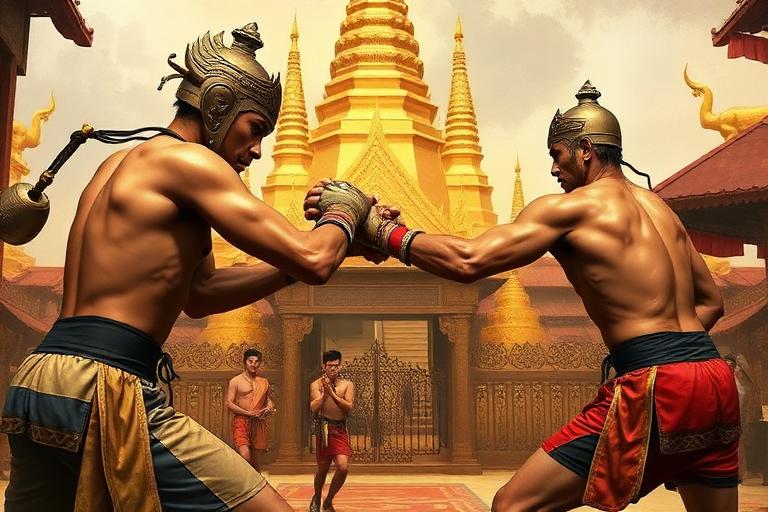
The History of Muay Thai: From Ancient Siam to Modern Sport
Muay Thai isn't just a sport — it's the cultural heartbeat of Thailand. With roots stretching back hundreds of years, it evolved from a battlefield martial art into one of the most respected combat sports on the planet. Here's its remarkable story.
Ancient Origins
Muay Thai's origins trace back to the ancient Siamese kingdom (modern-day Thailand). The earliest forms of Thai martial arts — known as Muay Boran ("ancient boxing") — were developed as close-combat fighting techniques for the military. Soldiers trained in striking with fists, elbows, knees, and shins, as well as weapons combat.
Unlike many martial arts that evolved primarily as philosophical or spiritual practices, Muay Thai was born from practical necessity — the need to defend the kingdom from invading forces.
The Legend of Nai Khanomtom
The most famous figure in Muay Thai history is Nai Khanomtom. According to Thai legend, in 1774, the Burmese army captured Siamese prisoners during the fall of Ayutthaya. The Burmese King organized a festival and ordered his fighters to test their skills against the Siamese.
Nai Khanomtom was selected to fight and reportedly defeated 10 Burmese fighters in a row without rest. The Burmese King was so impressed that he granted Nai Khanomtom his freedom. To this day, March 17 is celebrated as "National Muay Thai Day" in Thailand in his honor.
The Modernization (1920s–1930s)
In the early 20th century, Muay Thai began its transformation from folk fighting to organized sport. King Rama VII promoted codified rules, weight classes, and the introduction of boxing gloves (replacing the traditional rope-bound hands known as "Kard Chuek"). Timed rounds, referees, and scoring systems were adopted, bringing structure to what had been largely unregulated bouts.
The two legendary stadiums — Rajadamnern (1945) and Lumpinee (1956) — became the spiritual homes of Muay Thai competition in Bangkok. To this day, winning a title at either stadium is considered the highest achievement in the sport.
The Golden Age (1980s–1990s)
The 1980s and 1990s are considered the Golden Age of Muay Thai. Legendary fighters like Samart Payakaroon, Dieselnoi, Saenchai, and Namsaknoi raised the technical level of the sport to new heights. Television broadcasts brought Muay Thai into every Thai household, and gambling on fights became deeply embedded in the culture.
Global Expansion
Muay Thai's global spread accelerated in the 2000s, driven largely by the rise of MMA. Fighters discovered that Muay Thai's clinch work, devastating kicks, and elbow strikes were incredibly effective in mixed martial arts. UFC champions like Anderson Silva, José Aldo, and Valentina Shevchenko all built their striking games on a Muay Thai foundation.
Today, there are Muay Thai gyms in virtually every country. The sport is recognized by the International Olympic Committee, and there are ongoing efforts to include it in the Olympic Games.
Cultural Significance
In Thailand, Muay Thai is more than a sport. The pre-fight ritual (Wai Kru Ram Muay) is a dance performed by fighters to pay respect to their coaches, families, and the spirit of the art. The traditional headband (Mongkon) and armband (Pra Jiad) carry spiritual significance. Traditional Muay Thai music (Sarama) plays throughout the fight, with the tempo increasing as the action intensifies.
Whether you're a casual fitness enthusiast or a competitive fighter, training Muay Thai connects you to a tradition that spans centuries. Every time you strap on shin guards and throw a roundhouse kick, you're participating in an art that warriors have practiced for generations.
Stay in the Ring
Get training tips, gear guides, and exclusive deals straight to your inbox.