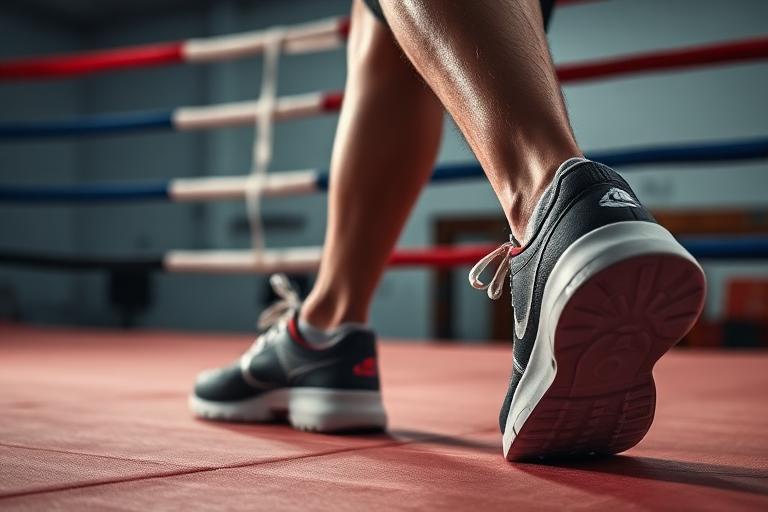
How to Improve Your Footwork in Boxing: Drills and Techniques
Footwork is what separates a good boxer from a great one. You can have the fastest hands in the gym, but if your feet are flat and slow, you'll never reach your potential. Here's how to develop footwork that keeps you in control of every exchange.
The Boxing Stance Foundation
Everything starts with your stance. Feet shoulder-width apart, lead foot pointing at your opponent, rear foot at roughly 45 degrees. Weight distributed 50/50 or slightly on the back foot. Knees slightly bent — never locked. Stay on the balls of your feet.
Basic Movement Patterns
The Step-Drag
The fundamental movement in boxing. To move forward: step with your lead foot first, then drag your rear foot to maintain your stance width. To move backward: step with your rear foot first, then drag your lead foot. Never cross your feet or bring them together.
Lateral Movement
Moving left: lead foot steps left, rear foot follows. Moving right: rear foot steps right, lead foot follows. Maintain your stance width at all times. Lateral movement is how you create angles and avoid getting trapped on the ropes.
The Pivot
The pivot is the most underused footwork technique among beginners. Plant your lead foot and rotate your body around it, moving your rear foot in an arc. This instantly changes your angle and puts you in a dominant position. Practice pivoting both directions.
Essential Footwork Drills
1. Box Drill
Imagine a square on the floor. Move to each corner using proper step-drag technique: forward, right, backward, left. Then reverse direction. Do 3-minute rounds. This builds your ability to move in all directions while maintaining stance.
2. Cone Weave
Set up 5–6 cones in a line, spaced about 3 feet apart. Weave through them using lateral movement, throwing a jab at each cone. This develops the ability to move and punch simultaneously.
3. Mirror Drill
Partner up with someone roughly your size. One person leads, the other follows — trying to maintain the exact same distance at all times. Switch roles every minute. This develops ring awareness and distance management.
4. Jump Rope
The single best footwork conditioning tool. Start with basic two-foot jumps, then progress to single-leg hops, side-to-side jumps, and running in place. Aim for 10–15 minutes per session.
5. Shadow Boxing with Purpose
Don't just shadowbox standing still. Throw a combination, then move to a new angle. Throw another combo, pivot. Every combination should end with footwork — either stepping out of range or circling to a new position.
Advanced Concepts
Cutting Off the Ring
When your opponent is moving away, don't chase them in a straight line. Move to cut off their escape route by stepping diagonally, herding them toward the ropes or corner. This is a fundamental skill for pressure fighters.
Creating Angles
After throwing a combination, step to the side rather than straight back. This puts you at an angle where you can see your opponent but they have to turn to find you. It's the difference between getting countered and being in a dominant position.
Common Mistakes
- Flat feet: Stay on the balls of your feet. Flat-footed fighters can't react quickly.
- Crossing feet: Never let your feet cross — you lose balance and mobility.
- Bouncing too much: Excessive bouncing wastes energy. Controlled, purposeful movement is the goal.
- Forgetting footwork during combos: Your feet should be moving before, during, and after every combination.
Spend at least 15 minutes of every training session on footwork drills. Your punches will hit harder, your defense will improve, and you'll control the pace of every sparring session. The best fighters in history — Ali, Lomachenko, Mayweather — all had exceptional footwork. Follow their example.
Stay in the Ring
Get training tips, gear guides, and exclusive deals straight to your inbox.