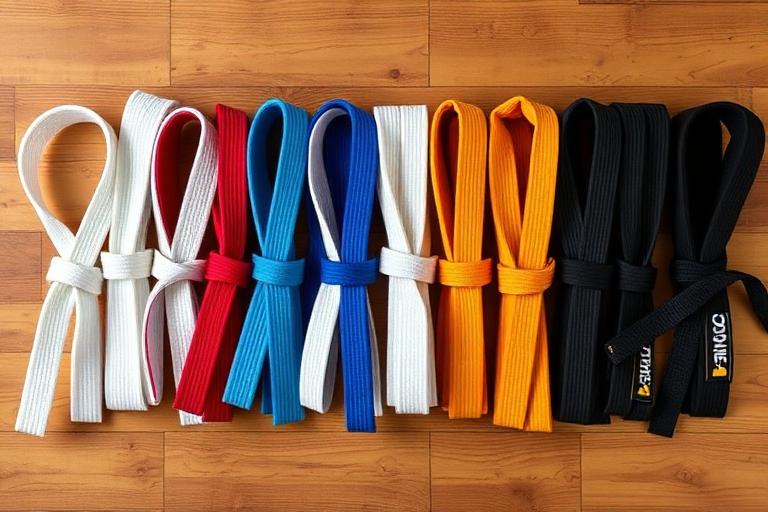
Beginner's Guide to the Brazilian Jiu-Jitsu Belt System
The Brazilian Jiu-Jitsu belt system is one of the most respected ranking systems in martial arts. Unlike many arts where you can earn a black belt in 3-5 years, a BJJ black belt typically takes 10-15 years of consistent training. Here's what each belt represents.
The Belt Progression
White Belt (Beginner)
Everyone starts here. As a white belt, you're learning the fundamentals: basic positions (guard, mount, side control, back), basic submissions (armbar, triangle, rear naked choke), and basic escapes. The goal is survival — learning to defend yourself on the ground.
Average time at white belt: 1-2 years
Focus: Learn to be comfortable in uncomfortable positions. Develop a basic guard game. Learn the language of BJJ.
Blue Belt
The blue belt is where most people feel like they "understand" BJJ. You have a working knowledge of positions, can execute basic techniques against resisting opponents, and are starting to develop a personal game — favorite positions, sweeps, and submissions that suit your body type.
Average time at blue belt: 2-3 years
Focus: Develop a coherent game plan. Start linking techniques together. Compete if interested.
Purple Belt
Purple belt is the "intermediate expert" level. You can handle most training partners at your gym, have a deep understanding of multiple positions, and are starting to teach lower belts. Your timing and transitions become smooth. Many consider purple belt the most fun — you know enough to be creative but are still discovering new things constantly.
Average time at purple belt: 2-3 years
Focus: Refine your A-game. Develop your B-game. Fix weaknesses. Help lower belts.
Brown Belt
Brown belts are polished. Their technique is crisp, their timing is excellent, and they have answers for most situations. Brown belt is essentially the "apprentice black belt" — you're preparing for the responsibility that comes with the highest rank.
Average time at brown belt: 1-2 years
Focus: Master your game. Eliminate holes. Develop coaching skills. Prepare mentally for the black belt journey.
Black Belt
The black belt represents mastery of the fundamentals and a deep understanding of BJJ as a complete system. But in BJJ culture, the black belt is seen as the beginning of a new journey, not the end. Black belts continue to learn, evolve, and teach for decades.
Average time to reach black belt: 10-15 years from white belt
Stripes and Degrees
Most gyms use a 4-stripe system at each belt level. Four stripes are typically earned before promotion to the next belt. After black belt, there are degrees (1st degree, 2nd degree, etc.) awarded based on time, contribution to the art, and continued excellence. A coral belt (7th degree) and red belt (9th-10th degree) exist for grandmasters.
How Promotions Work
Unlike many martial arts, BJJ has no standardized testing curriculum. Promotions are given at the discretion of your instructor based on:
- Technical knowledge and execution
- Performance in rolling (live sparring)
- Time on the mats (consistency matters more than frequency)
- Competition results (helpful but not required)
- Attitude, character, and contribution to the gym community
Tips for Faster Progression
- Be consistent: 3-4 classes per week beats 6 classes one week and none the next
- Take notes: Write down techniques after each class
- Roll with everyone: Big, small, experienced, beginners — each partner teaches you something different
- Compete: Competition accelerates growth by exposing weaknesses
- Study film: Watch instructional videos and competition footage
- Don't chase belts: Focus on improvement, not promotion. The belt will come when you're ready
The BJJ belt system rewards patience, consistency, and genuine skill. There are no shortcuts — and that's what makes every promotion so meaningful. Gear up with a quality rash guard and fight shorts, and enjoy the journey.
Stay in the Ring
Get training tips, gear guides, and exclusive deals straight to your inbox.